Qwen3.8-27B Q8_0 on two Radeon RX 7900 XT 20GB cards (Linux)
Candidate
Candidate Linux dual-split configuration for RX 7900 XT 20 GB; no published fit or performance result.
What will be tested
| Card | 2 × AMD Radeon RX 7900 XT 20GB, one model split across both cards |
|---|---|
| Operating system | Linux |
| Backend | Not yet selected |
| Model | Qwen3.8-27B (Apache-2.0) |
| Model file | Unsloth GGUF conversion, Q8_0 |
| Context | 16,384 tokens |
| Concurrent requests | 1 (one request at a time) |
| Placement | Full GPU |
| Reviewed | Not yet |
| Sources | Upstream model · GGUF file page |
What to expect
No published results yet. Measured results appear here only after testing and review.
Install
Candidate — no installer yet.
Overview
This Linux candidate proposes splitting one pinned Qwen3.8-27B Q8_0 model across two RX 7900 XT 20 GB cards with a layer split, one active request and 16,384 context. Each card would hold a portion of the model; the result is not two independent answer workers. A split could make the Q8 artifact worth testing where one card cannot meet its estimated free-memory requirement, but transfers between cards may offset any capacity benefit. Neither aggregate advertised VRAM nor a requested full-layer count proves fit, residency or faster generation.
The 16K context comes from this exact Q8 catalog profile and its conservative reserve estimate. Some single-card Q4/Q6 profiles specify 32K, but that does not establish that this Q8 pair is limited to 16K or that the longer single-card setting would fit here. Compare matched contexts when testing latency or throughput.
Requirements
The current private Linux guided launcher accepts one Vulkan GPU, so this two-card configuration is a proposed extension, not a runnable FastLLM recipe today. A future launcher must bind both devices and verify the exact model and consent before serving. Before attempting two cards, verify the motherboard has two usable slots and record the PCIe lanes and link speed each card actually negotiates. Check the complete system's power-supply connections/capacity and case airflow against both boards; no generic PSU minimum is established here. Identify both cards individually, leave memory reserves on each, and measure sustained thermals. A pair's advertised VRAM is not one contiguous pool.
The pinned GGUF is 29,047,086,048 bytes (29.05 GB decimal). Keep more free local SSD space than the artifact itself for verified acquisition and cache maintenance; no fixed extra margin or host-RAM minimum has been qualified. Review the exact model license before acquisition. A trial must record the exact device pair and topology, each card's current free VRAM, the requested split, per-card model and compute buffers, host-memory use, API output and repeated response times. Splitting capacity and two separate replicas answer different buyer needs.
Separate Flash-Next research
Qwen3.8-Flash-Next is a different model under separate Qwen Community 1.0 terms, not this pinned 27B artifact. Every full-model conversion surveyed so far has more weight data than this pair's combined GPU memory, so Flash-Next here would depend on host-memory offload. It remains research, not a recipe. Strata's AMD HIP documentation describes Linux AMD multi-card layer splitting and host expert caching but one AMD card per model on Windows. A separate exact artifact, runtime, RAM/SSD and output-quality review is needed before any FastLLM recipe.
Limitations
- The requested layer split and full-GPU placement have no qualified two-card load, buffer, correctness or speed result.
- The current Linux guided launcher is single-GPU; a two-card FastLLM runner is not implemented.
- The Q8 16K context is the catalog candidate, not a measured maximum.
Bitworks listings for this card
-
In stock
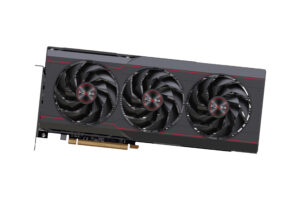 Sapphire
Sapphire PULSE AMD Radeon RX 7900 XT 20GB GDDR6 Gaming Graphics Card
$599.99 Manufacturer refurbished