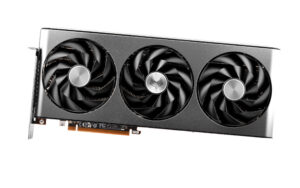
The RX 7800 XT offers 16 GB of GDDR6 memory. Its candidate Qwen3.5-9B Q8 profile uses the same pinned artifact as several other 16 GB cards, making a future matched comparison possible. The card still needs its own driver, free-memory observation and completed-output evidence; equal memory labels do not establish equal speed.
For a desktop used for both display and inference, record what else occupies GPU memory before testing the 32K catalog context. A different quantization may trade file size against response quality, so compare representative tasks rather than only download size. The larger Qwen3.8-27B profile is a separate experiment, not an established alternative on this card.
Loading (calculated). This card's FastLLM model, Qwen3.5-9B Q8_0 (9.53 GB), loads in at least 1.4 s from a PCIe 4.0 NVMe drive and 17.3 s from a SATA SSD; the drive sets that, not the PCIe generation. A reload from system memory takes 0.30 s at PCIe 4.0 x16 (0.60 s at 3.0).
Engine. FastLLM, in development, uses llama.cpp's Vulkan engine on this card. Bitworks has no lab observation for this card yet. AMD lists this card as RDNA3, gfx1101, in its ROCm GPU specifications. FastLLM's HIP engine currently covers only the RX 7900 XT and XTX.
Resizable BAR. Turn it on; it matters most for the Vulkan engine this card uses. If FastLLM detects it off, it applies its workaround and shows how to turn it on. The workaround is a fallback, not a replacement.
Driver. Use AMD Software: Adrenalin Edition, the current WHQL Recommended release. Our test PCs use the Minimal install option.
Power and cooling. AMD lists a typical board power of 263 W and recommends a power supply of at least 700 W, with more than 54 A on the 12 V output, for its reference system (AMD specifications). Plan airflow for sustained load, not short bursts.
Related reports from the same author or project — not independent replication
FP16 · 1 card · Windows · Ollama ROCm · by wilenkristoffer on GitHub
Reported on GitHub by wilenkristoffer — posted 2026-09-16 Original report
RX 7800 XT controlled concurrency — native Windows Ollama arm
Method (as reported): One warmup per runtime, then one barrier-released burst at each C1/C2/C4/C8 level during 2026-09-14 to 2026-09-16.
HEAD seen at retrieval: 1746e1dfdd1a (not necessarily the commit the author measured)
Reported GPU setup RX 7800 XT 16GB (gfx1101)
GPU count 1
Operating system Windows (Windows 11 native)
Environment Bare metal
Engine Ollama 0.34.1
Backend ROCm
Model Qwen2.5-1.5B-Instruct FP16
Configured context 4,096 tokens
Actual input input length not reported
Full window tested no
Reported context The 300-token request ceiling reportedly bound; stored authoritative output counts are unavailable.
Topology single (One GPU; separate recorded bursts at C1, C2, C4 and C8, with one runtime owning the card at a time.)
CPU AMD Ryzen 5 5600X
Memory configuration 32 GB DDR4-3200
Memory speed 3200 MT/s
Not reported: simultaneous clients, system memory, Exact model artifact, digest and Ollama runtime build commit, Actual concurrency-prompt token counts, server slots and worker-process count, Whether each row used API completion tokens or the SSE chunk-count fallback, Independent repetitions, variance, graded correctness and sustained reliability
The pinned client requests usage counts but falls back to nonempty content SSE chunks; the absent raw database leaves the numerator source unresolved.
The common batch wall starts before thread creation and ends after joins, so it includes client thread overhead.
One recorded burst per concurrency level supplies no independent repetition or variance.
This older small Qwen2.5 FP16 comparison is not current Qwen3.5/3.8, FastLLM, or a full-window fit result.
FP16 · 1 card · Linux · vLLM ROCm 7.2.4 · by wilenkristoffer on GitHub
Reported on GitHub by wilenkristoffer — posted 2026-09-16 Original report
RX 7800 XT controlled concurrency — WSL2 vLLM arm
Method (as reported): One warmup per runtime, then one barrier-released burst at each C1/C2/C4/C8 level during 2026-09-14 to 2026-09-16.
HEAD seen at retrieval: 1746e1dfdd1a (not necessarily the commit the author measured)
Reported GPU setup RX 7800 XT 16GB (gfx1101)
GPU count 1
Operating system Linux (Ubuntu 24.04 guest on Windows 11 host)
Environment WSL2 guest on Windows
Engine vLLM 0.29.0+rocm723
Backend ROCm 7.2.4
Model Qwen2.5-1.5B-Instruct FP16
Configured context 4,096 tokens
Actual input input length not reported
Full window tested no
Reported context The 300-token request ceiling reportedly bound; stored authoritative output counts are unavailable.
Topology single (One GPU; separate recorded bursts at C1, C2, C4 and C8, with one runtime owning the card at a time.)
CPU AMD Ryzen 5 5600X
Memory configuration 32 GB DDR4-3200
Memory speed 3200 MT/s
Host notes Windows 11 host; Ubuntu 24.04 guest under WSL2.
Not reported: simultaneous clients, system memory, Exact model artifact, digest and vLLM runtime build commit, Actual concurrency-prompt token counts, server slots and worker-process count, Whether each row used API completion tokens or the SSE chunk-count fallback, Independent repetitions, variance, graded correctness and sustained reliability
The pinned client requests usage counts but falls back to nonempty content SSE chunks; the absent raw database leaves the numerator source unresolved.
The common batch wall starts before thread creation and ends after joins, so it includes client thread overhead.
The WSL2 boundary and runtime differences prevent treating this as a native-Windows engine comparison.
This older small Qwen2.5 FP16 comparison is not current Qwen3.5/3.8, FastLLM, or a full-window fit result.
Method (as reported): Structured server harness; parallel one, FA, q4_0 K/V; four to six repeats per point.
Reported GPU setup RX 7800 XT 16GB
GPU count 1
Operating system Windows (Windows, version not reported)
Engine llama.cpp
Backend HIP/ROCm
Model Qwen3.8-27B Unsloth-Dynamic-derived IQ4_XS mixed tensors
Configured context 65,536 tokens
Actual input input length not reported
Reported context One row occupied about 7000 tokens; the other occupied about 48000.
Simultaneous clients 1
Server slots 1
Workers 1
Topology single
Speculative decoding MTP off for context-depth comparison
21.85 tok/s — generation speed (per request) · API server · 1 client About 7000 occupied tokens at configured 65536; q4_0 K/V This row: speculative decoding: off
8.77 tok/s — generation speed (per request) · API server · 1 client About 48000 occupied tokens at configured 65536; q4_0 K/V This row: speculative decoding: off
22.15 tok/s — generation speed (per request) · API server · 1 client Compared with 18.62 tok/s (MTP on versus off for one long generation); reported difference: speculative decoding Separate reported comparison at configured 32K; not the context-depth pair This row: configured context: 32,768 tokens · speculative decoding: MTP on
Not reported: Exact GGUF digest, llama.cpp build, Driver revision, CPU and RAM, Physical WDDM residency
The configured window is not the occupied input.
Earlier author measurements were corrected; use these corrected points only.
The default fit setting had silently moved layers to CPU in some runs.
MTP worsened the author's multi-step agent wall time; the long-generation comparison is not an agent guarantee.
Discussion
Share setups, questions and your own results. Posts are reviewed before they appear. Replies from Bitworks staff are marked.